.png)
Banarasi vs Every Other Saree: What Actually Makes It Different
India weaves more distinct saree traditions than any other country weaves textiles, full stop. Kanjivaram in Tamil Nadu, Paithani in Maharashtra, Chanderi in Madhya Pradesh, Jamdani in Bengal, Patola in Gujarat — each a complete design language of its own. So when someone says a Banarasi saree is "different," it is fair to ask: different how, exactly?
The answer sits in four things: where the ornamentation lives, how the zari behaves, what the motifs remember, and what the drape does in a room. This is a working comparison, not a beauty contest — every weave below is a masterpiece tradition. But they are masterpieces of different kinds, and knowing the difference is how you buy well.
What Is a Banarasi Saree?
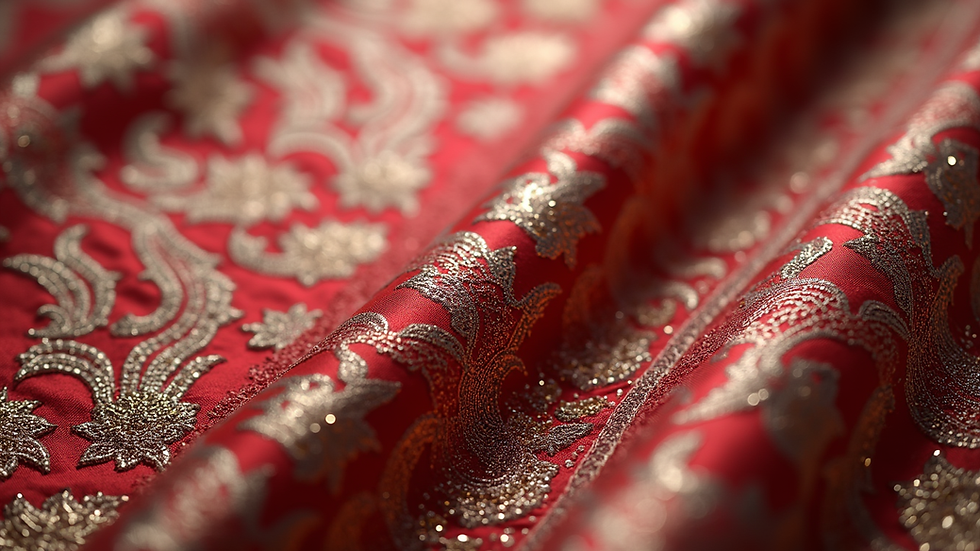
A Banarasi saree is handwoven in and around Varanasi (Banaras), Uttar Pradesh, on traditional looms, characterised by brocade weaving — supplementary zari or resham threads woven into the fabric itself to form motifs, rather than embroidered or printed onto it afterward. The classic vocabulary includes buta and buti (repeated floral motifs), jaal (an interconnected lattice), kalga and bel (paisley and vine borders), and a densely woven grand pallu.
Banarasi brocades carry Geographical Indication (GI) protection, which ties the name to the Varanasi region legally — a "Banarasi" saree woven elsewhere is not, in the protected sense, Banarasi at all.
The Four Real Differences
1. The ornamentation is woven in, not added on
Many beautiful sarees achieve their surface through embroidery, printing, or dyeing. Banarasi achieves it structurally: every gold buti is a decision made during weaving, thread by thread. Hold a pure Banarasi to the light and turn it over — the reverse shows the floats and traces of the same motifs, because the design and the fabric are one object. This is also why a genuine Banarasi takes anywhere from a fortnight to several months on the loom.
Patola (double ikat) shares this "design is the fabric" character, but arrives at it by resist-dyeing the yarns before weaving — a completely different discipline. Chikankari, by contrast, is embroidery on finished fabric; Kalamkari is drawn or block-printed.
2. The zari is the protagonist
Zari appears across Indian weaves, but Banaras made metal thread its native language. The signature Sona Rupa work — gold and silver zari used together in one motif — produces a dual-tone shimmer that shifts as you move, something a single-metal weave cannot do.
Kanjivaram also uses magnificent zari, but differently: its drama is architectural, concentrated in broad contrast borders and pallus joined by the korvai technique, over lustrous, heavier mulberry silk. Banarasi distributes its metal across the body in buti and jaal — the shimmer travels the whole saree rather than framing it. Kanjivaram announces; Banarasi glimmers.
3. The motifs carry Mughal memory
Banarasi design absorbed Persian and Mughal court aesthetics — the intricate floral jaal, the mehrab (archway) forms, the kalga paisley — refined over centuries of weaving for royalty. Paithani speaks a different heritage entirely: peacocks, lotuses, and the famous kaleidoscopic tissue pallu of the Deccan. Jamdani whispers in fine muslin geometry. Sambalpuri carries Odisha's ikat shankha and chakra. Same country, different civilisational archives — and you can read which archive a saree comes from at ten paces.
4. The family of weaves under one name
"Banarasi" is not one fabric but a house of them: Katan (pure silk, the classic), tissue (light-catching sheer with zari weft), organza/kora, georgette Banarasi, cotton Banarasi, and satin-weave families like Mashru — historically woven with a silk face and cotton back, prized for its liquid satin surface and comfortable fall. Kota doria — the featherweight square-check weave — is traditionally associated with Rajasthan but is also woven by Banaras clusters with buti and zari accents, marrying airiness to Banarasi ornament.
Few other traditions offer this much range under one roof: the same design language available in bridal-weight silk, office-weight cotton, and everything between.
Banarasi vs the Major Weaves, Briefly
Banarasi vs Kanjivaram. Both are the bridal heavyweights. Kanjivaram: heavier South Indian mulberry silk, bold contrast borders, temple motifs, korvai joins. Banarasi: finer drape, Mughal florals, all-over brocade, dual-metal zari. A Kanjivaram feels regal and structured on the body; a Banarasi feels ornate and fluid. Many brides ultimately own both — one for the ceremony, one for the reception.
Banarasi vs Chanderi. Chanderi is about translucence — a glassy, featherlight silk-cotton with sparse buti. Choose Chanderi for sheer summer elegance; choose Banarasi when you want the weave itself to be the ornament.
Banarasi vs Paithani. Paithani's genius is its pallu — an interlocked tapestry of peacocks and blooms — with a relatively plain body. Banarasi spreads its complexity across the whole field.
Banarasi vs Jamdani. Jamdani is arguably Banarasi's closest technical cousin — supplementary-weft motifs, woven by hand — but on gossamer cotton muslin, with no metal. Jamdani is poetry in cotton; Banarasi is the same grammar spoken in silk and gold.
Banarasi vs Sambalpuri/Patola (ikats). Ikats dye the pattern into the yarn before weaving, giving those signature feathered edges. Brocade weaves the pattern with extra threads, giving crisp, raised motifs. Neither is superior; they are opposite philosophies of putting a picture into cloth.
So Is Banarasi "Better"?
Better is the wrong axis. Banarasi is distinct in a specific, verifiable way: it is the Indian weave that made woven metal its medium, that carries a Mughal design archive on a GI-protected loom tradition, and that offers that language across the widest range of fabric weights. If what you want is ornament that is structural rather than applied — shimmer that belongs to the cloth, not sits on it — nothing else in India does precisely what Banaras does.
That is also why a pure Banarasi behaves differently over time: it does not shed its beauty, because its beauty is not a layer. It is the fabric.


Comments